Table of Content
To further explore stock splits, please refer to Investopedia. Companies like Home Depot tend to split stocks after big gains to keep them affordable for smaller investors, though the underlying value doesn't change. It also helps make options cheaper and acts as a sort of first-down marker in the stock's appreciation, a signal the stock has achieved a significant advance and is ready for a reset.
But its above-average price per share might still result in a stock split in the future. A lower share price would also change Home Depot's weight in share-price weighted indices, such as the Dow Jones Industrial Average . Due to a high price per share, Home Depot has a pretty high weight in that index today, at 6%, making it one of the top 3 components of the 30-stock index.
Get Split History
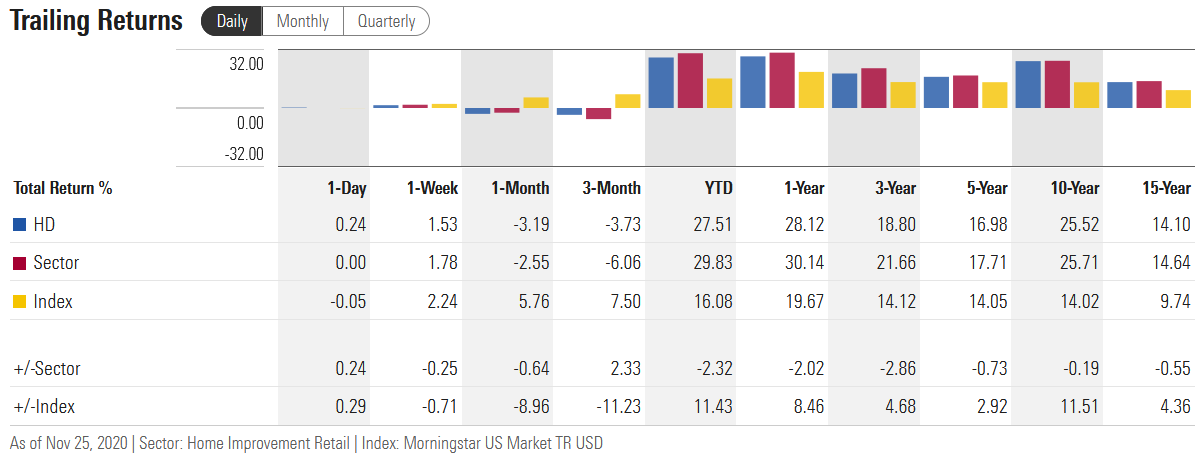
Depending on future earnings multiples and potential outperformance versus current expectations, returns could also be higher than that. Home Depot has, despite not opening a large number of new stores, managed to grow its sales and profits at an attractive pace in recent years. Same-store sales growth, combined with margin expansion thanks to operating leverage, resulted in ample profit growth. When we look at Home Depot's earnings per share growth, we see an even better performance, thanks to the impact of share repurchases that lowered the company's share count over the years. Between the growth of the stock price and the dividend increases, Home Depot has delivered incredible returns since its IPO. Instead of doing my own calculations, I turned to the company's website, which offers a handy calculator on its stock.
Essentially, the company has split its shares every one and a half years or so during the 1980s and 1990s, a time during which Home Depot experienced rapid earnings growth and strong share price gains. Back then, when fractional share buying was not available through most brokers, the price per share mattered a lot more compared to today, when most investors can buy fractions of a share easily. Splitting shares regularly thus made sense for Home Depot, as the company could thereby keep its share price in a desired range. A stock split does not change the fundamental value of a company. Meaning a Home Depot stock split will not make the business more valuable. However, there is a psychological benefit in that the share price will be lower after the split, making shares seem more accessible to everyone and thus temporarily increasing demand and ramping up share prices.
Will Home Depot Stock Split?
As you can see, the stock surged from its IPO in 1981 to the end of the tech boom in 1999. From then the stock moved sideways under the misguided leadership of Bob Nardelli. Nardelli ran the home-improvement retailer from December 2000 to January 2007. Despite presiding over the company during the biggest housing boom in modern history, the stock lost 8% during his tenure, while shares of rivalLowe'smore than tripled during that period. Home Depot's success story shows the immense rewards that can be reaped by investing early in a great company and holding the stock for a long time. Even a small initial investment can make you a millionaire several times over if your timing and stock picks are right.
Instead, Home Depot’s leadership stated that if and when it wants to create additional value for shareholders, it is more likely to look at repurchasing stock. First, several major players in the Dow Jones Industrial Average have allowed their prices to creep up – in some cases, close to $300 per share. While it's not a member of the Dividend Aristocrats -- that select group of companies that have raised their dividends every year for at least 25 years -- it nearly qualifies. Management has raised the dividend annually since 1987 with the exceptions of 2007, 2008 and 2009, when it took a pause during the housing bust. Let's take a look back at Home Depot's stock history to find out how much you'd have today if you had invested $1,000 at its IPO. Founded in 1993 by brothers Tom and David Gardner, The Motley Fool helps millions of people attain financial freedom through our website, podcasts, books, newspaper column, radio show, and premium investing services.
Stock Split History
While shareholders sometimes fixate on a split, it adds no value for investors. The market capitalization sometimes referred as Marketcap, is the value of a publicly listed company. In most cases it can be easily calculated by multiplying the share price with the amount of outstanding shares.
Overall, I think that the return outlook for Home Depot is attractive at current prices, but not outstanding. The lower valuation, despite slightly higher growth, is why I own Lowe's right now, but I think that opting for Home Depot - or going with both - is not at all a bad idea, either. Since growth will, due to the aforementioned law of large numbers, likely slow down eventually, it seems realistic to assume that Home Depot's earnings multiple could decline in coming years. If Home Depot were to trade at 20x net profits at the end of 2025, that would result in a share price of $412, which would equate to a 26% return from the current level, or about 6% a year. Add in Home Depot's dividend, and a high-single-digit return over the next couple of years seems highly realistic, I believe.
Home Depot is simply packaging the number of outstanding shares in a different way. For example, in a 2-for-1 split, the amount of shares will double . Say you have 100 shares of Home Depot, then the day of the split you will receive 2 shares for every 1 share you hold in your brokerage account, meaning you will receive 200 shares on the stock split date. However, the price of the stock will reflect this change and your holding of Home Depot will remain practically the same. Since the last Home Depot split, there has been a general market-wide trend away from stock splits.
Its first stores in the Atlanta area were significantly bigger than those of its competitors, which helped drive the company's initial momentum and positioned its brand as a one-stop-shop for home improvement. I/we have a beneficial long position in the shares of LOW, MSFT, AMZN either through stock ownership, options, or other derivatives. The company's shares are trading higher than they traded when management decided to split them in the past. While this is not financial advice and we have not run any thorough studies on the matter, general consensus is that price tends to go up after the announcement of a stock split and before the stock split itself happens. In the meantime, investors can enjoy reliableHome Depot stock dividends, which have increased steadily every year. However, Home Depot has never relied on market norms to make this decision, and it didn’t split its stock in 2018.
Get stock recommendations, portfolio guidance, and more from The Motley Fool's premium services. I wrote this article myself, and it expresses my own opinions. I have no business relationship with any company whose stock is mentioned in this article. Cold weather and economic uncertainty have impacted both the housing market and the retail industry, but there is every reason to believe that prices will perk up again.

Management may be hesitant to split shares due to the impact on index weighing, and potential selling from ETFs. Option usage would be easier following a stock split, however. There might be rumors of a Home Depot stock split, but the truth is that until the board proposes a shares split to its shareholders, it's all just noise. The rise of discount brokers has made it possible for small investors to purchase odd numbers of shares, so the per-share price is less of a concern than it was 20 years ago.
As for a future stock split, it looks like those days may be over. Following Nardelli's departure, Home Depot suffered through the recession and has been booming since. With shares now near $130, the stock is higher than at any point during its stock splits. DividendInvestor.com features a variety of tools, articles, and resources designed to help investors interested in dividend stocks find the best dividend stocks to buy. We provide opinion articles, detailed dividend data, history, and dates for every dividend stock, screening tools, and our exclusive dividend all star rankings. At $328, shares are currently offering a dividend yield of exactly 2.0%, while Home Depot's earnings multiple stands at 22.5 based on earnings per share estimates for the current year.

Based on those numbers, if you had invested $1,000 in Home Depot's IPO and reinvested the dividends, you would have approximately $11.5 million today. Because of inflation, your actual buying power would be more equivalent to $4.07 million in 1981 dollars. However, there's no denying that those are mind-boggling returns that underscore the remarkable power of compound growth.


No comments:
Post a Comment